NYNNE NOEL: ASTROCARTOGRAPHY AT HIGH
LATITUDES ‒ BETWEEN LATITUDE AND LIGHT
February 14, 2026
Preserving the Legacy of Licensed Astrocartography
©2026 by Kristine Odegard
Reposted from: www.astrocartography.frEuropean Astrocartography Interview Series 2025‐26 Among the new generation of European astrocartographers, Nynne Noel brings a perspective shaped by both geography and lived experience. Dividing her time between Denmark and Greenland, she has become one of the first voices to explore how extreme latitude influences astrocartographic interpretation.
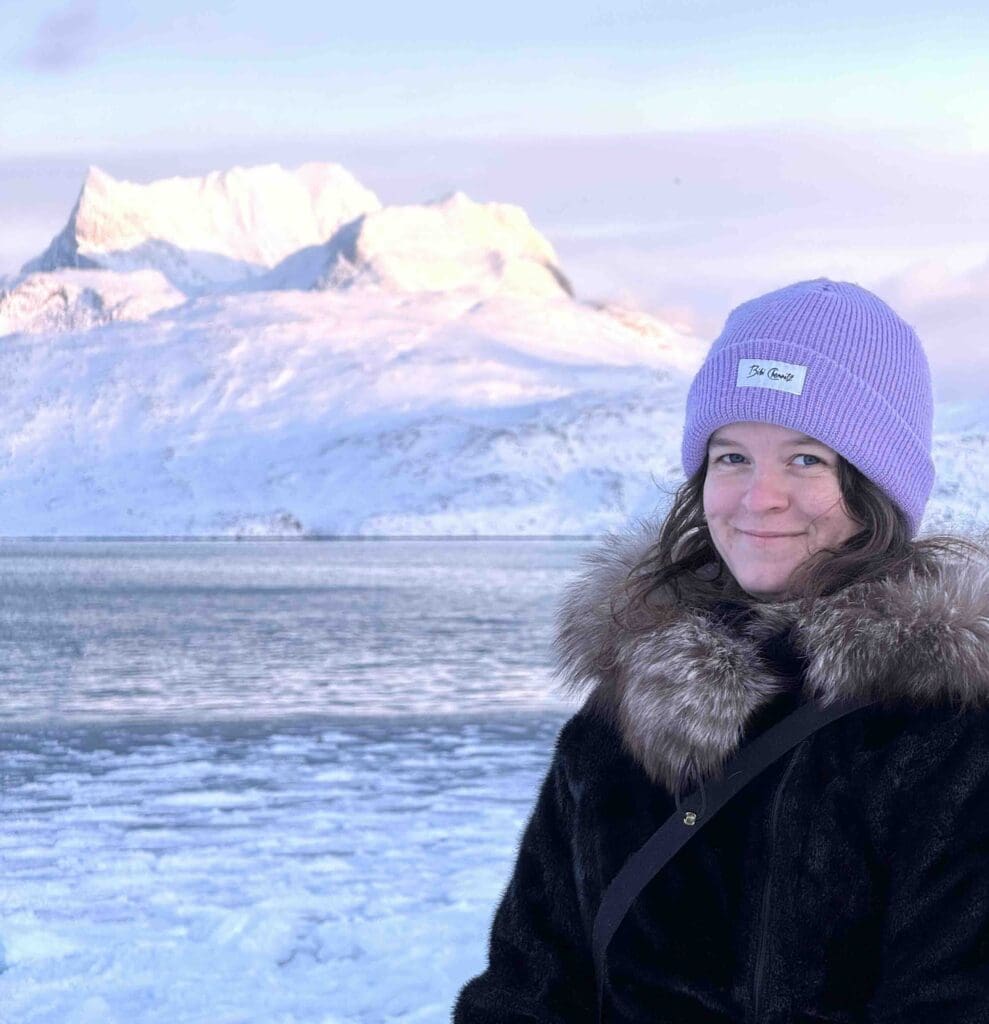
Nynne Noel photographed in Nuuk, Greenland
Recently graduated from the Astromapping certification at Kepler College, Nynne represents a growing movement of professionally trained astrologers committed to rigorous standards and ethical clarity. She is also the only Danish-speaking astrocartographer currently offering consultations in her native language creating a vital bridge between Nordic and international practice.
Our conversation explored the shifting energies she experiences between Denmark and Greenland, the hidden mechanics of high-latitude mapping, and how astrocartography can illuminate questions of identity, relationship, and place.
Aerial view of a Greenlandic settlement, reflecting the high-latitude environments explored in this astrocartography interview.
Early Encounters with the Map
"I started studying astrology when I was very young, reading books I found on my mother’s bookshelf. In my teens I focused mainly on Sun-sign astrology, and in my twenties I began exploring the full horoscope and the other planets, gradually expanding my knowledge."
"I first became aware of astrocartography in 2017. For several years, I explored it on my own, using it personally rather than working with it professionally."
Like many practitioners, Nynne’s interest in astrocartography began as a personal experiment. Her early experiences with relocation brought questions that no ordinary travel guide could answer. What she later discovered through relocating to Greenland confirmed what she had already intuited ‒ that place acts as a mirror, amplifying or muting certain aspects of the self, often quite surprisingly.
Today, she integrates traditional ACG, Local Space, numerology and counselling-based insight. The result is a style of practice that feels both grounded and exploratory ‒ part cartography, part personal archaeology.
Living Between Denmark and Greenland
"I was born in Denmark, but I’m often in Greenland. It’s where I did my primary internship, as well as work experience. I also have family ties there."
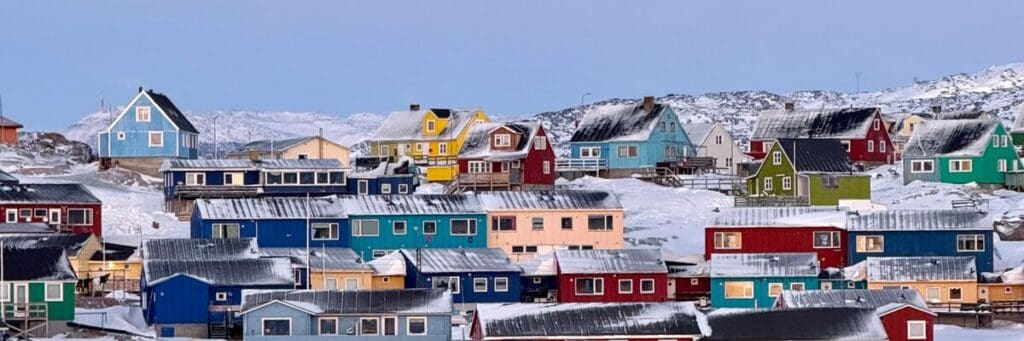
At the time, in 2017, Nynne’s work in Greenland was not astrological. Her background is in pedagogy, and her early professional training and internships took place there, grounding her relationship to the country in daily life, responsibility, and long-term human engagement rather than temporary travel.
Today, when Nynne speaks about her life between Denmark and Nuuk, from an astrocartographical standpoint, it becomes clear that this is more than a geographical contrast ‒ it’s a study in personal transformation.
The same chart unfolds through two very different environments ‒ shaping experience in distinct ways.
Two Places, One Map & Relationships
WEST COAST OF DENMARK
"In Denmark, I have a natal Neptune ACG line close to the West Coast where I currently live. In Greenland, I have a natal Mercury ACG line all the way down the major cities on the west coast."
When Nynne compares her life in Denmark and Greenland, she does so through repeated, lived experience rather than abstract theory. The same natal chart is expressed in two distinct environments, and the contrast has been felt most clearly in her relational life.
"Love hasn’t been very lucky in Denmark, except for a few years when Venus progressions were active there."
Even when interest is mutual, momentum falters. Delays, misunderstandings, and a sense of emotional fog mark her experience, making continuity harder to establish.
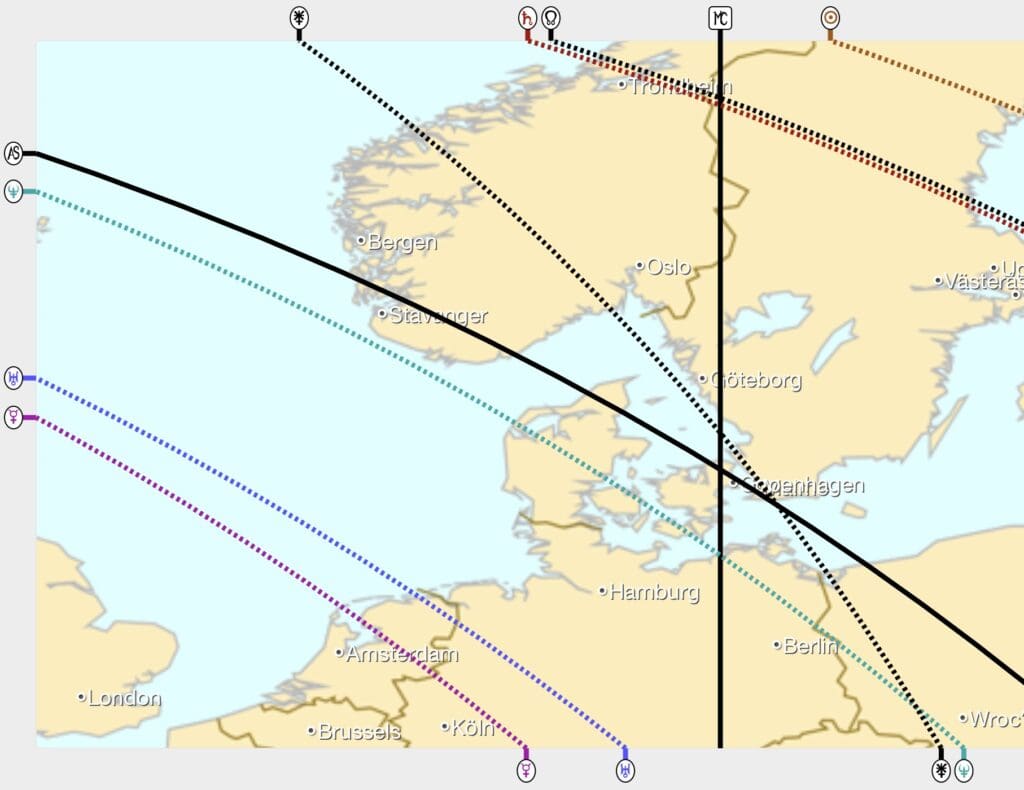
For Nynne, relationships tend to feel more difficult to sustain in Denmark. She describes patterns where connection seems possible at first, yet quickly dissolves once daily life takes hold. Dating has been marked by delays, misunderstandings, and a sense of emotional fog. Even when interest is mutual, momentum struggles to carry forward.
NUUK, GREENLAND
"In Greenland my experience with love and a potential partner has been very possible and more available for me. I have been feeling very in love and lovable."
Encounters unfold with greater ease, and she experiences herself as more open, engaged, and emotionally present. When either she or a potential partner returns to Denmark, the dynamic often changes abruptly.
"As soon as either I or the other touched down in Denmark, it fell apart. When I went back to Greenland, love started flowing again."
This contrast has repeated itself often enough for her to recognise it as a pattern rather than coincidence. Greenland is not a place she visits briefly; it is somewhere she lives, works, and returns to over time. The shift remains consistent across multiple stays.
"It’s a very interesting experience for me. I have really experienced how love life can work through both ACG and CCG."
Conversation flows more easily, curiosity is heightened, and engagement feels reciprocal rather than effortful. These observations were grounded in experience first. Only later did she reflect on the astrology.
The question that follows is not whether the map reflects her experience, but why such contrasts become especially pronounced in places like Greenland—where geography itself begins to behave differently.
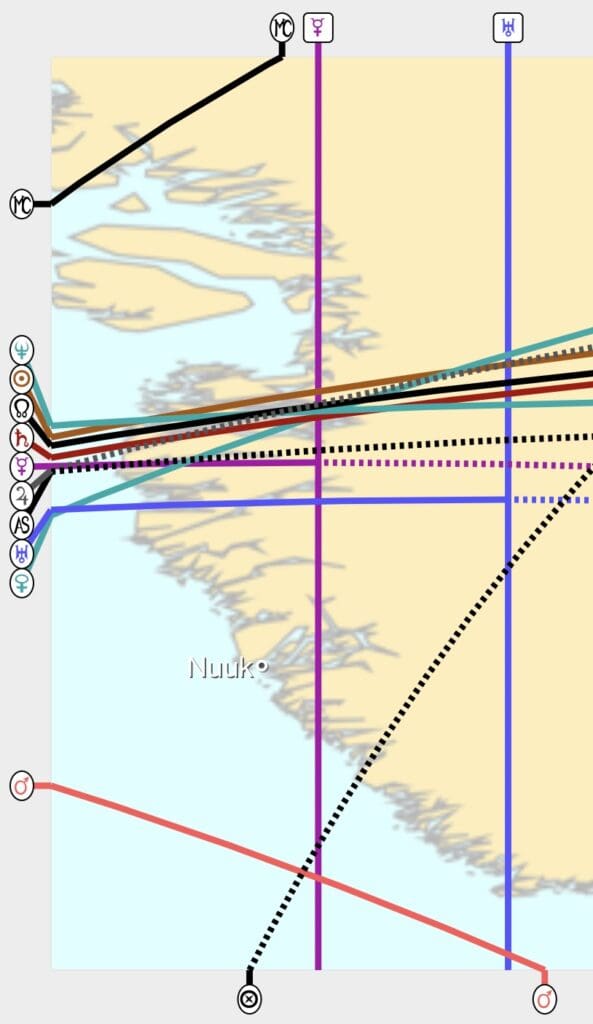
Living at the Edge of the Map
In places like Greenland and other high-latitude regions, geography itself alters the conditions under which astrocartography operates.
This is not a speculative idea. From the earliest years of astromapping, practitioners working with global projections noticed that the map behaves differently as one approaches the polar regions. The closer one moves toward the Earth’s extremes, the more the familiar assumptions about angularity begin to loosen.
Taken together, these perspectives describe a consistent phenomenon: at high latitudes, astrocartography remains valid, yet it no longer behaves exactly as it does in mid‐latitude regions.
To understand why Nynne’s experience shifts so markedly in Greenland, we now need to look at what happens to the map itself.
Ptolemy with an armillary sphere (c. 1474‐1476), attributed to Joos van Ghent and Pedro Berruguete, Louvre Museum.
TECHNICAL NOTE
Jim Lewis was explicit that astrocartography remains mathematically valid at extreme latitudes. What changes is not the map itself, but the way angular relationships compress as one approaches the poles. This convergence creates visual density without guaranteeing intensified lived experience ‒ a distinction later explored in practice by Erin Sullivan during her field research.
"Where this many lines cross, they would tend to cancel one another out and have much the same effect as no lines at all; still, it would be an intense place and one which most people have found unpleasant ‐ for the climate, if for no other reason."
‒ Jim Lewis & Arielle Guttman, The AstroCartoGraphy Book of Maps
"By the time we get up to 60° north or south, to the polar circles, you get an increasingly distorted picture of our view of local celestial space. This is where you see the great convergence of all ASC/DSC lines. I call them vortices."
‒ Erin Sullivan, Where in the World? AstroCartoGraphy & Relocation
So Astrology Works Differently Up There?
Astrologer and author Erin Sullivan is among the few who examined how astrology behaves at extreme latitudes. Her work shows that as one approaches the polar regions, the familiar geometry underlying astrological charts begins to distort. At high latitudes, angular relationships compress and longitudinal measurements converge, and the separation between Ascendant, Midheaven, and house structure no longer behaves as it does at mid-latitudes. Charts formed under these conditions tend toward overlap and prolonged angularity rather than discrete events.
Sullivan’s work provides an essential reference point for understanding why astrocartographic experience shifts in regions such as Greenland, without reducing those experiences to theory alone.
Erin Sullivan (1947‐2023) whose work brought astrocartography into wider professional practice through teaching and publishing.
The Physics of Latitude
Astrocartography is built on angular relationships ’ planets rising, setting, culminating, or anti-culminating in relation to a specific location. At most inhabited latitudes, these anglesoccur in a predictable daily rhythm. As latitude increases, that rhythm progressively weakens.
Classical armillary sphere illustrating the horizon, meridian, ecliptic and celestial poles used in astronomical modelling.
Near the polar circles, planets may rise and set at shallow angles, remain close to the horizon for extended periods, or fail to rise or set altogether. The Sun itself abandons the familiar diurnal cycle. Instead of discrete angular moments, astrologers encounter duration, overlap, and simultaneity.
This shift has direct consequences for the map.
As longitudinal measurements converge toward the poles, astrocartographic lines cluster visually. What appears as heightened activity on the map is often a projection effect rather than an increase in interpretive clarity. Lines compress. Distinctions blur. Multiple angular relationships may operate at once.
This compression helps explain why "more lines" do not necessarily produce clearer outcomes. Rather than isolated events, experience becomes immersive. Activation spreads across time instead of concentrating at moments.
For this reason, many practitioners adopt methodological limits when working at high latitudes. Software such as Astro Gold allows latitude ranges to be constrained, not to deny influence beyond those limits, but to preserve interpretive usefulness. Beyond approximately ±60°, angular behaviour becomes increasingly unreliable as a primary indicator.
The concept of a limit of latitude reflects this practical reality. It does not suggest that astrology stops functioning. It acknowledges that certain techniques rely on assumptions about rising, setting, and culmination that weaken as latitude increases.
To understand why astrocartographic interpretation shifts at extreme latitudes, it is necessary to return to the astronomical foundations of the craft. Astronomy for Astrologers by John and Peter Filbey provides essential context, explaining how celestial coordinate systems and apparent planetary motion transform as latitude increases.
By clarifying the physics of horizon geometry, declination, and angular relationships, the text helps explain why conventional assumptions about rising, setting, and angular separation begin to weaken near the poles. This perspective supports the lived experience described by contemporary practitioners, framing high-latitude astrology as a change in astronomical conditions rather than a change in astrology itself.
Understanding the mechanics of the astronomy of astrology allows lived experience ’ like Nynne’s ’ to be read with precision rather than mystification.
END TECHNICAL NOTE
From Backpacking to Self-Mapping
"I have travelled quite a bit in my early 20s, and have been to 29 countries. When I discovered astrocartography, I went through almost every former location I had been in order to compare the ACG lines with my own experience at the time visiting."
Long before astrocartography became a formal part of her work, travel itself was already functioning as Nynne’s primary laboratory.
Moving repeatedly between countries, climates, and cultures, she began noticing consistent emotional and psychological patterns long before she had the technical language to describe them. Certain locations felt socially open, curious, and connective. Others demanded responsibility, emotional depth, or restraint. At the time, these impressions remained experiential rather than analytical.
Only later, when she returned to her own astrocartography maps, did those memories begin to align with specific planetary activations. This retrospective mapping became a turning point. Instead of just moving through space, travel became a way of reading the chart and confirming experiences. The map did not predict the journey. It explained it.
Backpackerrejsen ‒ Backpacking in the Horoscope
"You don’t really understand a line until you’ve lived it", Nynne Noel, 2025.
Out of this process emerged a consultation approach designed for travellers, students, and people in transitional phases. Drawing directly from her own experiences, Nynne first developed a format she called Backpackerrejsen ‒ Backpacking in the Horoscope ‒ which later evolved into her broader service Your Astrological Worldmap.
Rather than offering promises or fixed outcomes, this approach encourages direct engagement with the map. In doing so, she integrates this concept into her wider astrocartography consultations. Short stays under different planetary lines become a form of reconnaissance: a way to feel how symbolism expresses itself through culture, climate, language, and daily rhythm before making long‒term decisions.
"Go to your different lines. Explore the energies and feelings there ‒ the possibilities and the restrictions."
In this model, astrocartography shifts from static analysis toward participatory practice. The chart is not something that dictates where one should go. It becomes something that is tested, observed, and refined through movement and experience.
Nynne is careful to challenge simplified narratives often associated with astrocartography."I really don’t like the general assumptions ‒ go to your Venus line and you will find love, stay away from Pluto, don’t ever invest on a Neptune line."
Instead, she emphasises context, the natal chart, and personal development. The same planetary line can manifest very differently depending on the individual, their life stage, and the broader chart structure.
"The outcome is very personal to the native. I always look for the personal development possibilities. I don’t do doom readings."
Travel itself, in this sense, becomes a way of learning the map slowly and honestly. Not as a shortcut to happiness, but as a method for understanding how identity adapts in motion ‒ and how place participates in that process.
Looking Ahead and New Directions
"People like being able to sit at home, follow their world map on the screen, and really take it in."
Looking ahead, she plans to expand her offerings. In 2026, she intends to develop Danish-language educational material, making astrocartography more accessible within the Nordic world, where resources remain limited despite growing interest.
She currently works primarily online, a format she values for its accessibility and depth as she balances her life between the west coast of Denmark and Copenhagen where she is completing training in psychotherapy.
Remote Activation
A Lemurian crystal from Brazil used in remote activation ‒ a technique in astrocartography that brings the symbolic energy of a place into the present environment when travel is not possible.
"For me, a crystal is not decoration. It is a way of staying in dialogue with a place when you cannot physically be there."
Chrome Diopside from Siberia
Nynne presents each stone in her shop with its geological origin and planetary correspondence. Rather than treating crystals as decorative objects, she links them to place and symbolism, exploring how physical materials can function as forms of remote activation ‒ tangible reminders of planetary and geographic connection.
About Nynne
Nynne Noel is a Danish astrologer and astrocartographer whose work is shaped by lived experience across latitude, culture, and geography. Dividing her time between Denmark and Greenland, she has developed a practice attentive to how place influences emotional rhythm, perception, and personal development, bringing a distinctly experiential perspective to locational astrology.
Certified in Astromapping through Kepler College, Nynne is the only Danish-speaking astrocartographer currently working with clients in her native language. Her focus is on how different locations can be explored as developmental environments rather than fixed promises or outcomes.
Alongside her astrological practice, she is completing training in psychotherapy in Copenhagen, a parallel discipline that informs her reflective and client‒centred approach without defining it. Her consultations integrate traditional astrology, astrocartography, local space principles, and counselling ‒oriented insight, with a strong emphasis on ethical practice and personal agency.
Through her work, Nynne continues to expand the dialogue between travel, identity, and place, offering a modern perspective on astrocartography.
Website: nynnenoel.dk
Editorial Closing
Nynne Noel represents a new generation of European astrocartographers whose work is rooted in lived geography as much as technique. Moving between Denmark and Greenland, she brings direct experience to questions that have long remained theoretical within the field.
Her practice highlights how astrocartography evolves at different latitudes, demonstrated through her own experience of the same relationship unfolding differently across locations, showing that place influences experience through subtle shifts in light, rhythm, and perception as much as through lines on a map. In this way, her work extends the tradition while grounding it in contemporary life.
As astrology continues to expand beyond familiar regions, voices like Nynne’s help bridge technical understanding with human experience ‒ reminding us that mapping the sky also means learning how we change as the world around us changes.
Continue exploring the European Astrocartography Interview Series:
Faye Blake Astrocartography ‒ Mapping the Business of Place A conversation on integrating astrocartography with professional direction, ecological awareness and strategic decision-making.
Anne C. Schneider Astrocartography ‒ Choosing the Sky for the Year An exploration of lived timing, relocation practice and the role of personal agency in locational astrology.
CREDITS: The background tile came from ABC Giant. The maps are from a free geographic clipart collection at Graphmaps. The animated globe is by Iband. Web design by Donna Cunningham



